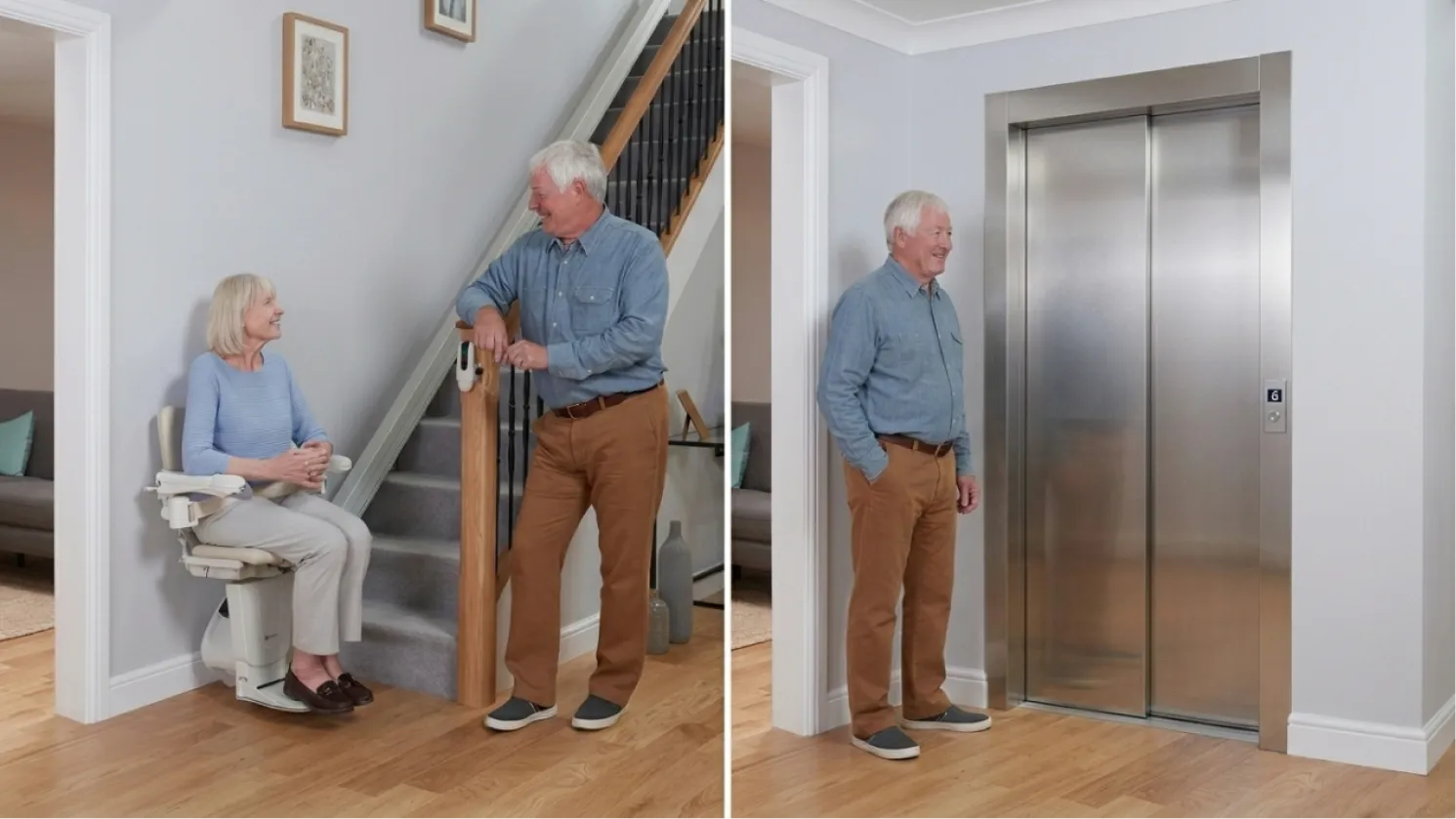
When a family member faces permanent or progressive physical challenges, retrofitting a multi-story house becomes an urgent priority. One of the most critical decisions homeowners face is choosing between a stairlift vs home elevator. Both technologies eliminate the danger of stairs, but they serve different physical capabilities, spatial requirements, and long-term care plans. Understanding the objective differences is vital for a sound investment.
The Case for Handicap Stair Lifts
A stairlift is a motorized chair that travels along a rail mounted securely to the treads of an existing staircase. This mobility solution is highly effective and remains the most common accessibility modification in residential spaces.
The primary advantage of a stairlift is its ease of integration. Because the rail fastens directly to the stairs rather than the wall, no major structural renovations are required. Installation can often be completed in a single day. Stairlifts are also highly adaptable; custom curved rails can be manufactured to navigate complex architectural layouts, including spiral staircases and multiple landings.
Functionally, a chair lift is ideal for individuals with moderate mobility impairments. The user must possess the core strength to sit upright and the physical ability to transfer from a standing position, a walker, or a wheelchair into the lift's seat. For individuals with arthritis, respiratory issues, or those recovering from surgery, a stairlift provides immediate, safe, and cost-effective access to upper floors.
The Case for Residential Elevators
A home elevator, conversely, is a vertical transportation platform enclosed within a shaft. Unlike commercial elevators, residential models are engineered to fit within the footprint of a standard home while adhering to strict safety codes.
Home elevators provide the ultimate level of barrier-free access. The most significant functional advantage is the complete elimination of transfer requirements. An individual utilizing a wheelchair can roll directly into the cabin, travel to the desired floor, and roll out without ever leaving their chair. Furthermore, modern residential elevators feature cabins spacious enough to accommodate the wheelchair user alongside a caregiver, which is critical for those with severe disabilities requiring constant assistance.
While elevators offer superior convenience and heavy-duty weight capacities, they require significant architectural planning. Installing an elevator usually involves constructing a hoistway, altering floor joists, and securing dedicated electrical lines, making it a larger-scale construction project.
Head-to-Head Comparison: Which is Right for You?
To make an educated decision between a stairlift and a home elevator, families must evaluate three core metrics:
- User Capabilities: If the Person with a Disability is strictly wheelchair-bound and cannot safely pivot or transfer to a seat, a home elevator is the only viable long-term solution. If the user can walk short distances but cannot navigate steps, a stairlift is highly practical.
- Spatial and Structural Requirements: Stairlifts require a staircase wide enough (typically at least 30 inches) to allow the chair to pass safely without obstructing foot traffic. When folded, premium models take up minimal space. Elevators require a dedicated vertical footprint through the floors of the home, which may necessitate sacrificing closet space or room corners.
- Budget and Timeline: Objectively, stairlifts represent a significantly lower initial financial outlay and offer rapid deployment. Elevators are premium architectural additions that require higher investment and longer lead times for construction and permitting.
Choosing the Best Disability Solution
Deciding between a stairlift vs home elevator ultimately depends on the specific, long-term medical prognosis of the disabled individual and the architectural constraints of the property. For immediate, practical assistance with minimal disruption, stairlifts are unparalleled. For comprehensive, wheelchair-friendly access that future-proofs the home for any level of mobility decline, residential elevators stand as the definitive solution. By assessing physical needs against home layout, families can invest confidently in the right mobility technology.