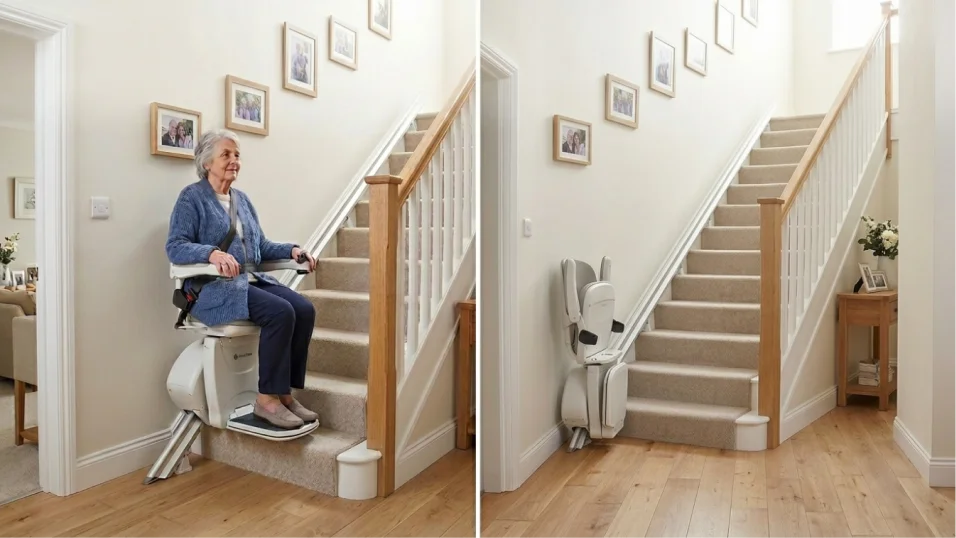
In many multi-generational Filipino households, the staircase is a high-traffic artery that connects the heart of the home. When a family member experiences mobility challenges, introducing a stairlift is often the most practical solution, yet concerns about compact chairlift features and potential obstructions for other residents frequently arise. For homes with narrow hallways or steep, slim staircases, understanding the mechanics of space-saving designs is essential to ensuring that accessibility does not compromise the safety or comfort of those still using the stairs on foot.
Modern engineering has evolved significantly from the bulky, intrusive designs of the past. Today’s premium mobility solutions prioritize a "slimline" philosophy, where every component—from the rail to the carriage—is designed to occupy the smallest possible footprint. This article explores the specific features that allow a chairlift to integrate seamlessly into a busy home, maintaining clear passage for everyone.
The Folding Trio: Seat, Arms, and Footrest
The most fundamental way a chairlift saves space is through its ability to "fold away" when not in use. A standard chairlift, when fully deployed, might extend significantly into the width of the staircase. However, high-quality models utilize a synchronized or independent folding system that reduces the unit’s profile to a mere fraction of its operational size.
1. Folding Seats and Arms
The seat and armrests are typically the widest parts of the lift. In premium designs, these components are engineered with a slim profile that hugs the wall. When the lift reaches its destination and the user alights, the seat and arms can be flipped upward. This simple action can save anywhere from 10 to 15 inches of stair width, which is critical in older Filipino townhomes where staircases may already be narrower than modern building codes suggest.
2. The Critical Role of the Folding Footrest
Perhaps the most important space-saving feature is the folding footrest. Because the footrest sits at floor level, it can become a significant tripping hazard for other family members if left down. Advanced models often feature a "linked" footrest, which means that when the seat is folded up, the footrest automatically follows suit. This eliminates the need for the user to bend down—a task that can be difficult for those with limited mobility—and ensures the stairway is immediately cleared for foot traffic.
The Role of the Slimline Rail
While the chair itself is visible, the rail (or track) is the permanent fixture that stays on the stairs 24/7. In the context of compact chairlift features, the rail design is often where the most significant space savings occur.
- Single Rail Systems: Some premium brands offer single-rail designs that sit very close to the wall or the banister. These rails are often less than 3 inches in diameter, minimizing the "encroachment" onto the treads.
- Vertical Rails: Unlike older models that might have a bulky rack-and-pinion system exposed, modern slimline rails are often designed with a vertical orientation. This allows the rail to be tucked tightly into the corner of the steps.
- Low-Profile Brackets: The brackets that secure the rail to the stairs are also a factor. Space-saving designs use low-profile mounting systems that do not extend further into the walking path than necessary.
Managing the "Parked" Position: Overcoming Hallway Obstructions
The footprint of a chairlift isn't just a concern on the stairs themselves; it’s also a factor at the top and bottom "landing" areas. If a stairlift stops directly at the bottom step, the chair might block a doorway or a narrow hallway. To solve this, several architectural "parking" solutions exist:
The Slide Track or Powered Hinge
If there is a doorway at the bottom of the stairs, a standard permanent rail would create a permanent obstruction across the floor. A powered hinge allows the lower portion of the rail to fold up and away automatically when the lift is not in use, leaving the doorway or hallway completely clear. Alternatively, a slide track allows the entire rail to move up the staircase along with the chair, ensuring that no part of the track remains at the base of the stairs when the lift is parked upstairs.
Parking Bends (Wrap-Arounds)
For homes with enough space at the landing, a "parking bend" can be installed. This allows the rail to curve 90 or 180 degrees away from the stairs, "parking" the chair around a corner or against a nearby wall. This leaves the entire width of the staircase open for other users and moves the chair out of the main walking path of the hallway.
Safety Considerations for Shared Stairs
When selecting a lift with compact chairlift features, it is vital to consider the "walk-past" clearance. Safety standards generally suggest that even with a lift installed, there should be enough room for an adult to pass comfortably and safely.
- Obstruction Sensors: Even the most compact lift must be safe. Modern units are equipped with sensors on the carriage and footrest. If the lift is moving and encounters an object (or a person) on the stairs, it will stop instantly.
- Offset Seating: Some designs utilize "offset" seating, where the chair sits slightly further back on the carriage to provide more knee room for the user without increasing the overall width of the unit.
Summary of Space-Saving Benefits
Designing for mobility in a compact home does not require sacrificing the accessibility of the staircase for the rest of the family. By focusing on synchronized folding mechanisms, slimline rail technology, and intelligent parking solutions like powered hinges, homeowners can achieve a balance between safety and spatial efficiency. When evaluating options, the goal is to find a system that "disappears" as much as possible when not in service, ensuring that the home remains a safe, navigable environment for every generation.