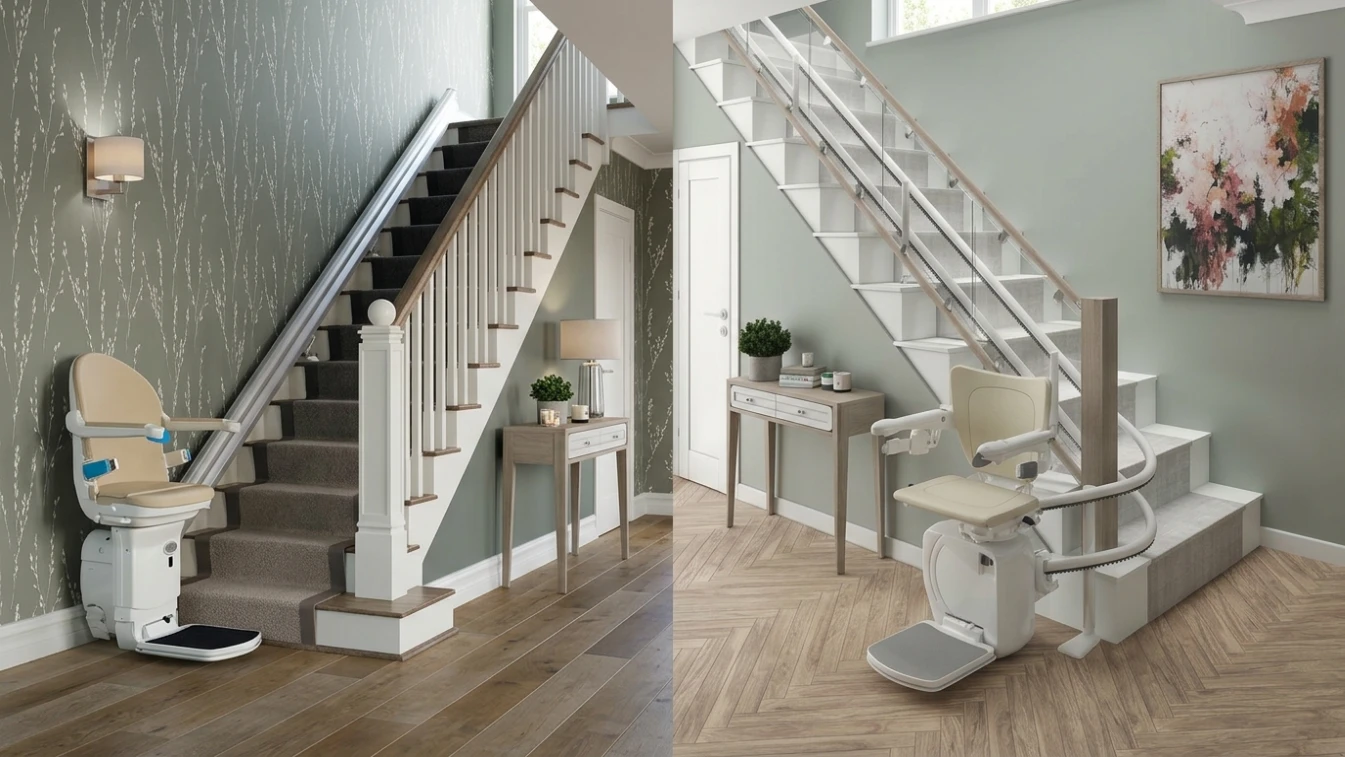
Mobility within the home is a cornerstone of independence, especially for seniors and individuals with physical challenges. In many Philippine households—ranging from narrow Manila townhomes to spacious suburban residences—the staircase often becomes a significant barrier. When considering a solution, the most fundamental question arises: do you need a straight or a curved stairlift?
While both serve the same primary purpose of transporting a user safely between floors, the engineering, installation process, and structural requirements differ significantly. Understanding these nuances ensures that the chosen stairlift types in the Philippines provide the highest level of safety and comfort for your loved ones.
Understanding Staircase Geometry
The architecture of your home dictates the type of lift required. Staircases generally fall into two categories: those with a single, uninterrupted flight of stairs, and those that incorporate turns, landings, or spiral designs.
Straight Staircases
A straight staircase is one that travels from the bottom floor to the top floor without any bends, curves, or intermediate landings. These are common in modern minimalist designs and smaller residential units.
Curved and Complex Staircases
Any staircase that features a turn (L-shape or U-shape), a half-landing, or a spiral design requires a curved rail system. In the Philippines, many older homes or multi-story residences utilize these designs to save space or add architectural flair. Because the rail must follow the exact contour of the wall or banister, these systems require a higher degree of customization.
Straight Stairlifts: Simplicity and Efficiency
Straight stairlifts are designed for simplicity. Because the rail only needs to travel in a fixed, linear path, the technology focuses on smooth starts and stops.
- Installation Speed: Since the rails are often pre-cut to standard lengths and then adjusted on-site, installation is typically fast, often completed within a few hours.
- Rail Design: The rails are usually made of extruded aluminum. They are slim and designed to take up minimal space on the tread of the stairs.
- Standardized Parts: Because the geometry is predictable, these units use standardized components, making them a highly reliable and cost-effective entry point into home mobility.
Curved Stairlifts: Engineering for Complexity
When a staircase involves a landing or a change in direction, a straight rail is no longer viable. This is where curved stairlift engineering becomes essential.
- Custom-Built Rails: Unlike straight rails, curved rails are custom-manufactured to the specific measurements of your home. Premium brands like Handicare often use photo-measurement technology to create a 3D map of the stairs, ensuring the rail fits perfectly within millimeters.
- Negotiating Landings: A curved lift can travel across a flat landing and continue up a second flight of stairs. This allows the user to remain in the seat for the entire journey, rather than having to transfer between two different lifts.
- Parking Solutions: One of the greatest benefits of a curved system is the ability to "park" the chair around a corner at the top or bottom. This keeps the staircase completely clear for other family members to use on foot.
Key Technical Differences
To help visualize the choice, consider that straight lifts are often 'off-the-shelf' solutions tailored to length, while curved lifts are fully bespoke engineering projects. The rail for a curved lift must account for the changing pitch and angle of the stairs to keep the chair perfectly level at all times.
Safety Features and Global Standards
Regardless of the type, all premium mobility lifts should adhere to international safety standards, such as EN 81-40. When evaluating options for a Philippine home, look for these objective safety features:
- Safety Sensors: These are located on the footrest and the carriage. If the lift encounters an obstacle on the stairs, it will automatically stop.
- Battery Backup: Given the occasional power fluctuations in some regions, a high-quality lift should operate on a DC battery system. This ensures the user is never stranded midway during a brownout.
- Swivel Seats: For safe entry and exit, the seat should swivel at the top landing so the user faces away from the stairs when standing up.
Summary
The decision between a straight and curved lift isn't just about the stairs; it’s about the user's specific needs and the architectural reality of the home. By focusing on the structural requirements and safety certifications of the equipment, families can ensure long-term reliability and peace of mind.